LMS
LMS
Last updated on 19th May 2026| 4560

- Introduction to Large Language Model Tutorial
- Foundations of AI and NLP
- Neural Networks Basics
- Transformers Architecture<
- Training Large Language Models
- Prompt Engineering Basics
- Applications of LLMs
- Popular Tools and Platforms
- Ethics and Responsible AI
Introduction to Large Language Model Tutorial
Large Language Model Tutorial (LLMs) are advanced AI systems trained on massive amounts of text data to understand and generate human-like language. They rely on deep learning, particularly transformer architectures, to capture context and meaning across sentences. For freshers, LLMs are exciting because they can write essays, answer questions, translate languages, and even generate code. Unlike traditional NLP models, LLMs scale with billions of parameters, enabling nuanced and coherent responses in Gen AI Course. They are interactive, responding to prompts with dynamic outputs. LLMs are widely used in chatbots, content creation, and knowledge retrieval. Their versatility makes them essential for modern AI applications. Beginners find them approachable through APIs and platforms like Hugging Face and OpenAI. LLMs also raise ethical questions about bias and responsible use. Learning them provides a gateway into cutting-edge AI careers.
Foundations of AI and NLP
- Core Concepts: Artificial Intelligence (AI) enables machines to simulate human intelligence, while Natural Language Processing (NLP) focuses on understanding, interpreting, and generating human language. Machine learning and deep learning form the foundation of modern NLP systems and large language models. To strengthen your fundamentals, explore the Artificial Intelligence Tutorial.
- Learning Path: Begin with mathematics, probability, statistics, and Python programming before learning supervised and unsupervised machine learning, NLP concepts such as tokenization and embeddings, and hands-on implementation using real-world datasets.
- Evolution of NLP: Natural Language Processing has evolved from rule-based systems to statistical models, neural networks, and transformer architectures such as BERT and GPT, significantly improving language understanding and text generation capabilities.
- Applications: NLP powers chatbots, virtual assistants, language translation, sentiment analysis, text summarization, search engines, question-answering systems, and intelligent business applications. Learn more through the Intelligent Apps Tutorial for a Promising Future.
- Importance for Freshers: Learning AI and NLP builds a strong technical foundation, prepares beginners for internships and industry projects, improves problem-solving skills, and creates career opportunities in artificial intelligence, machine learning, and generative AI.
Get Your Gen AI Certification by Learning from Industry-Leading Experts and Advancing Your Career with ACTE’s Gen AI Course.
Transformers Architecture
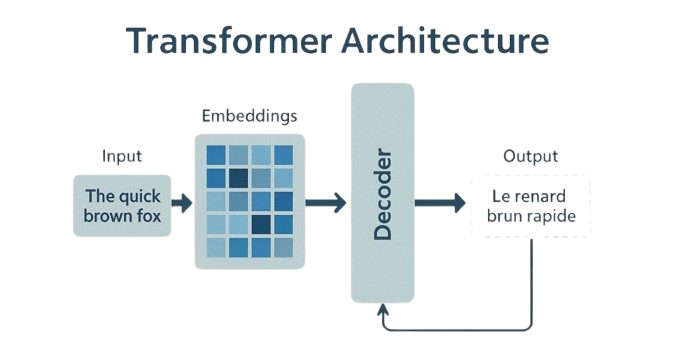
- Encoder: The encoder processes input text by capturing contextual relationships between words using self-attention mechanisms. It generates meaningful representations that enable models to understand language, making it an essential component in transformer-based architectures such as BERT.
- Decoder: The decoder generates output sequences by attending to encoded information and previously generated tokens. It is widely used in language generation, translation, summarization, and conversational AI models such as GPT.
- Self-Attention: Self-attention enables transformer models to understand relationships between words regardless of their position in a sentence, improving contextual understanding and language accuracy. Learn more about advanced AI technologies through the Robotics Tutorial.
- Positional Encoding: Positional encoding provides information about the order of words within a sequence, allowing transformers to preserve sentence structure while supporting efficient parallel processing during training and inference.
- Applications: Transformer architectures power modern AI systems including GPT, BERT, T5, and other large language models used for chatbots, machine translation, text summarization, question answering, content generation, and intelligent search applications.
Neural Networks Basics
Neural networks are the backbone of LLMs, inspired by the human brain’s structure. They consist of input, hidden, and output layers connected by weights. Each neuron processes inputs, applies an activation function, and passes results forward. Training involves adjusting weights using backpropagation and gradient descent in Gen AI Course . Activation functions like ReLU and sigmoid introduce non-linearity, enabling complex learning. Neural networks can approximate almost any function, making them powerful for tasks like text recognition and generation. Overfitting and underfitting are common challenges, solved with techniques like dropout and regularization. When multiple layers are stacked, networks become “deep,” forming deep learning systems. AI and NLP systems learn hierarchical representations directly from raw data. For freshers, mastering neural networks is essential before tackling transformers and LLMs. They form the foundation of modern AI applications.

Training Large Language Models
Training LLMs involves feeding massive datasets into transformer architectures. The process requires GPUs or TPUs for handling billions of parameters. Data preprocessing ensures quality, removing noise and balancing sources. Models learn by predicting the next word in sequences, gradually improving accuracy. Training is resource-intensive, often requiring distributed systems. Fine-tuning adapts pre-trained models to specific tasks like summarization or Q&A in Gen AI Course. Evaluation metrics include perplexity, accuracy, and human feedback. Challenges include bias, overfitting, and high computational costs. For freshers, understanding training concepts builds appreciation for the scale of Large Language Models. While they may not train full models, they can experiment with fine-tuning smaller versions. Training knowledge prepares learners for advanced AI roles.

Get JOB Oriented Gen AI Training for Beginners By MNC Experts
- Instructor-led Sessions
- Real-life Case Studies
- Assignments
Prompt Engineering Basics
- Definition: Prompts guide model outputs. Templates standardize inputs. Context improves relevance. Experiment widely. Prompt design is critical. Freshers must practice.
- Techniques: Use clear instructions. Add examples. Provide context. Test variations. Techniques improve results. Beginners gain skill.
- Evaluation: Compare outputs. Gather feedback. Adjust prompts. Document findings. Evaluation ensures quality. Freshers gain confidence and get Knowledge in Intelligent Apps Tutorial.
- Applications: Summarization tools, translation systems, creative writing apps, and Q&A bots. Applications show utility and inspire innovation.
- Best Practices: Document prompts. Share templates. Reuse designs. Collaborate with peers. Best practices improve efficiency. Freshers learn professionalism.
Want to Master Gen AI? Explore the Gen AI Master Program Offered at ACTE Today!
Applications of LLMs
Large Language Models (LLMs) are transforming industries by automating language-based tasks and improving productivity. Businesses use LLMs to power intelligent chatbots, virtual assistants, customer support, content creation, and workflow automation. In education, they assist with personalized learning, research, assignment preparation, and knowledge discovery. Healthcare professionals use LLMs to summarize medical records, generate clinical documentation, and support decision-making, while developers leverage them for code generation, debugging, and software documentation. Creative industries benefit from AI-powered writing, storytelling, marketing, and media production. To explore another important AI domain, visit the Object Detection Tutorial. Understanding these real-world applications helps beginners recognize the growing impact of LLMs across business, education, healthcare, research, and generative AI solutions.
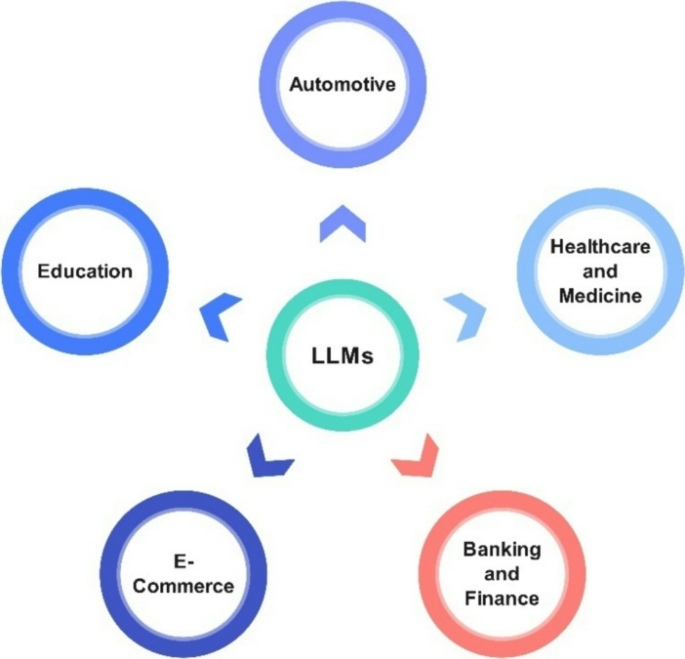
Large Language Models (LLMs) also improve accessibility by generating image alt text, simplifying complex documents, translating content, and assisting users with diverse communication needs. In software development, they support code generation, debugging, documentation, and test case creation, while in finance they automate report generation, risk analysis, compliance tasks, and data interpretation. To strengthen your understanding of the deep learning concepts behind these systems, explore the Artificial Neural Network Tutorial. Their versatility makes LLMs valuable across education, healthcare, business, research, and software engineering. By experimenting with real-world LLM applications, beginners develop practical AI skills and gain hands-on experience in building intelligent solutions that improve productivity, creativity, and decision-making.
Want to Learn About DevOps? Explore Our DevOps Interview Questions and Answers Featuring the Most Frequently Asked Questions in Job Interviews.
Popular Tools and Platforms
- Frameworks: Popular AI frameworks such as TensorFlow, PyTorch, Keras, and Hugging Face provide powerful tools for building, training, and deploying machine learning and large language models.
- Platforms: Google Colab, Jupyter Notebook, Kaggle, AWS, Microsoft Azure, and Google Cloud Platform (GCP) provide cloud-based environments for developing, testing, training, and deploying AI applications, making them ideal for beginners and professionals.
- Utilities: AI development is supported by APIs, preprocessing libraries, visualization tools, deployment platforms, and model evaluation frameworks that simplify application development and improve productivity. Learn more in the Generative AI Tutorial.
- Learning Approach: Begin with Google Colab and Jupyter Notebook for hands-on practice, experiment with Hugging Face models, build projects using PyTorch or TensorFlow, and gradually deploy applications on cloud platforms to gain practical AI experience.
- Best Practices: Use virtual environments, maintain updated dependencies, document project workflows, version-control code with Git, and create reproducible notebooks to build reliable, scalable, and professional AI development practices.
Ethics and Responsible AI
Ethics is central to Large Language Model Tutorial because of their power to generate convincing outputs. Bias in training data can lead to unfair or harmful results. Deepfakes highlight risks of misuse, raising concerns about authenticity and trust. Responsible AI emphasizes fairness, transparency, and accountability. Developers must ensure outputs are accurate and unbiased. Privacy is another concern, as Large Language Models may inadvertently expose sensitive information in Gen AI Course. Regulation and guidelines are emerging to govern responsible use. For freshers, learning ethics is as important as technical skills. It prepares them to build AI systems that benefit society. Ethical awareness ensures AI development remains safe, fair, and trustworthy.